
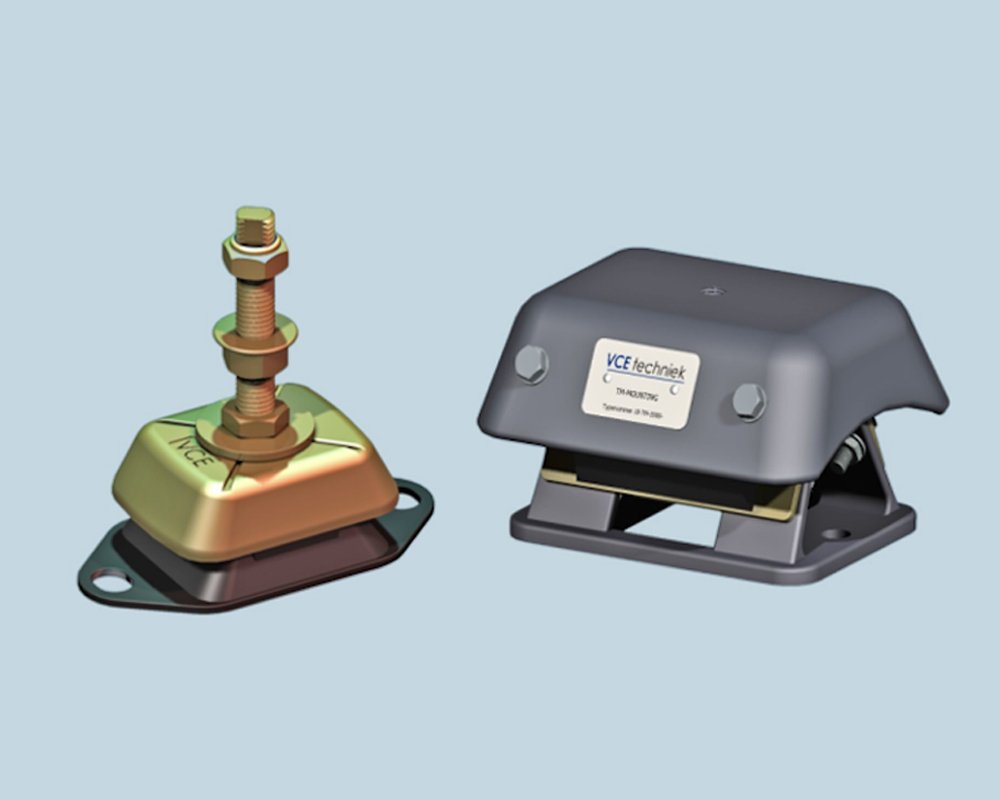
How we should decide to use which type/model of elastic mounts for our rotating machinery? Vibration and shock can cause a variety of problems for equipment, including:
- Reduced performance and accuracy
- Increased wear and tear
- Fatigue and failure
- Noise and discomfort
Vibration isolation and shock protection techniques can be used to protect equipment from these harmful effects.
When discussing vibration protection, it is useful to identify the three basic elements of dynamic systems: the equipment, the support structure, and the resilient member (elastic mounting).
The function of the elastic mounting depends on whether the equipment or the support structure is the source of the vibration and/or shock. If the equipment is the source, the elastic mounting reduces the force transmitted from the equipment to the support structure. If the support structure is the source, the elastic mounting reduces the dynamic disturbance transmitted from the support structure to the equipment.
The principle of isolation is the same in both cases. The elastic mounting, being a resilient element, stores the incoming energy at a time interval which affords a reduction of the disturbance to the equipment or support structure.
Vertical Vibration
Isolation is attained by maintaining the proper relationship between the disturbing frequency and the system's natural frequency. The natural frequency is the frequency at which the system will oscillate on its own if displaced from its equilibrium position. If the disturbing frequency is equal to the system's natural frequency, the system will be in resonance and the disturbance forces will be amplified rather than reduced. Therefore, it is important to select an elastic mounting with a natural frequency that is different from the disturbing frequency.
In Figure 1, the graph of transmissibility versus disturbing frequency ratio can be seen. Transmissibility is a measure of how much the vibration is amplified or attenuated by the elastic mounting. The graph shows that isolation begins when the disturbing frequency ratio is greater than 1.4.